
Sustainability in planning
LCA in focus – ELITECAD supports you every step on the way
With the EU Green Deal and other regulations such as ESG criteria, digital product passport (DPP), GWP comparisons, increased compliance requirements, etc., sustainability, climate neutrality and resource conservation are increasingly taking centre stage in planning processes and general market requirements. Transparency regarding environmental parameters, life cycle data and material origin is becoming a prerequisite - whether for certifications, subsidies or future mandatory certificates such as the digital product passport.
ELITECAD Architecture supports you in incorporating sustainability considerations directly into your planning. Previously, this often required the use of estimated values, time-consuming data collection and manual calculations to create reports in Excel, for example. Now your building model itself serves as a central source of information and makes relevant LCA data from ÖKOBAUDAT directly available. This gives you detailed insights into the environmental impact of your planning.

The transparent results are ideal as verification for certifications, in the context of the circular economy or to support project financing. Instead of investing time in complex processes, you can concentrate on creative design – ELITECAD Architecture takes care of the precise calculation and documentation of your sustainability aspects. This makes ecological construction an integral part of your workflow – efficient, practical and future-proof.
EPD attribution
A key feature of ELITECAD Architecture is the efficient integration of environmental indicators - in particular the numerous characteristic values from Environmental Product Declarations (EPDs) – directly into the building model. In the past, it was a challenge to bring this information into the model without a flood of data or confusing, duplicated attributes. ELITECAD solves this problem with predefined assignments between materials and EPDs – even retroactively for existing projects.
This means you benefit from this functionality without any additional effort. The assignments can be flexibly customised, for example for project-specific or regional requirements. Assignments are made at the touch of a button and significantly speed up the entire process. The stored data can be used in a variety of ways: for visualisations, plan labels, evaluations and reports. This gives you a clear overview of the sustainability aspects of your project and enables you to make informed decisions.


Thanks to the direct connection to ÖKOBAUDAT, verified EPD data is immediately available to you in ELITECAD. Updates are automatically taken into account so that you always work with reliable values.
This saves time when researching and ensures greater efficiency in planning – with a full focus on design and quality.
This saves time when researching and ensures greater efficiency in planning – with a full focus on design and quality.
Attribute colours for sustainability criteria
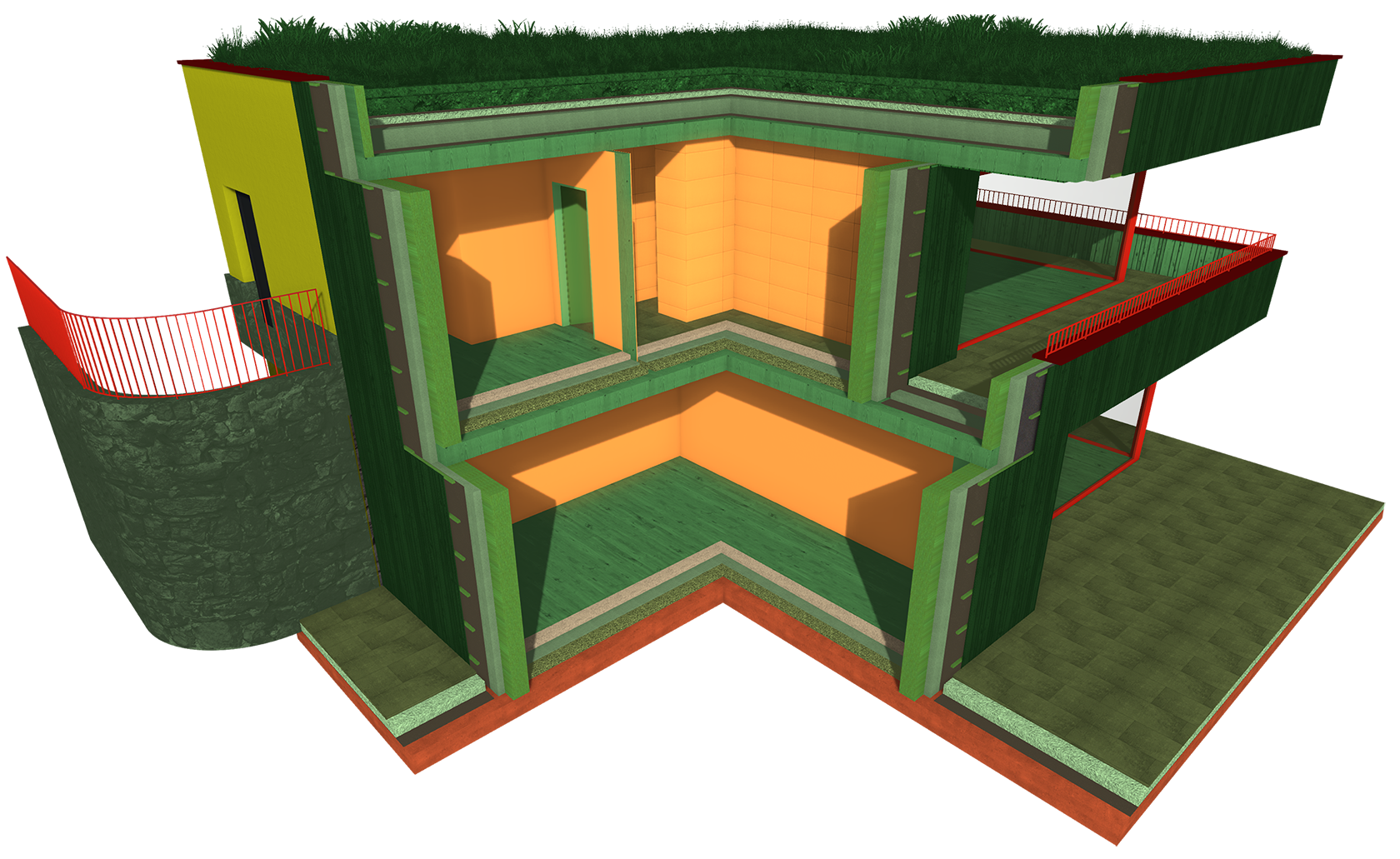
The attribute colours for sustainability criteria give you a clear overview of the environmental impact of the materials used – for example, with a colour scale from green to red to make the carbon footprint of the building materials visible at a glance. This intuitive visualisation makes it easier to make informed decisions and helps you to identify more sustainable alternatives. Complex data is presented in an understandable way, which simplifies analyses and speeds up the development of environmentally friendly solutions. You work more efficiently and actively contribute to the quality and sustainability of your projects.
Layouting and documentation
The previously manual and error-prone labelling of components such as walls or ceilings is significantly simplified by automatic documentation using attribute stamps. Information such as layer thicknesses and materials are taken directly from the model and automatically updated when changes are made. The visualisation can be flexibly adapted and additional attributes can be added as required – for example EPD data, which forms an important basis for sustainability reports.
Automatically generated QR codes turn your plans into interactive documents. With a simple copy and paste, embed links to relevant information – from EPDs and contact details to product details. This saves time, improves collaboration and strengthens the sustainable planning approach.
Evaluation reports with diagrams
Automatically generated analysis reports with clear diagrams allow you to easily understand and present complex data. Whether pie charts for material distributions or bar charts for energy efficiency – every visualisation gets to the heart of your planning at a glance.

With the new reports, you can, for example, determine the CO₂ impact of the construction of a new building. You can also analyse the consumption of non-renewable energy for renovation projects or other construction phases. Or you can use the building resource passport for detailed information on the quantities of materials used in terms of material requirements and recyclability, so you always have all the relevant values for sustainable decisions at your fingertips.
Even customised or complex components can now be seamlessly integrated into your calculations. From free-form shapes to special material properties – everything is precisely recorded and taken into account in your reports. This gives you a comprehensive insight into the effects of your planning ideas and enables you to make well thought-out decisions.